Viewing the SUN from Sky & Telescope web site.
The Sun radiates abundant light, so much so that to view it safely we must use filters that allow only a fraction of a percent of that light into our eyes.
So protected, we can study the nearest star in either white light or choose among several narrow wavelengths, the most common of which are red hydrogen-alpha and violet calcium K-line light. White light filters reveal the glaring face of the Sun called the photosphere, home to granulation, a rice-grain texture of rising and sinking convective cells; faculae, bright patches of concentrated magnetic energy; and sunspot groups that come and go as the rotating Sun carries them in and out of view.
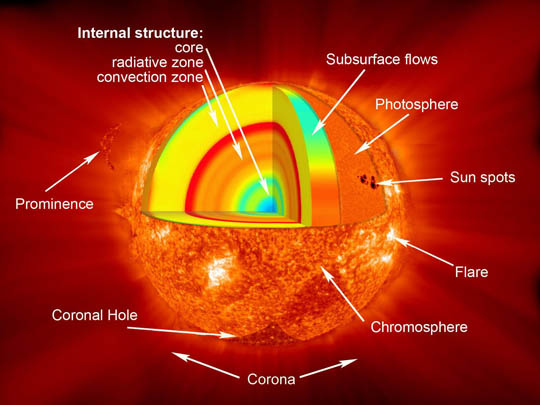 Cutaway of the
Sun showing its core, where nuclear fusion occurs, radiative zone, convection
zone and the three layers of its atmosphere: photosphere, chromosphere and
corona.
Cutaway of the
Sun showing its core, where nuclear fusion occurs, radiative zone, convection
zone and the three layers of its atmosphere: photosphere, chromosphere and
corona.
NASA
White light filters provide a simple and inexpensive way to get to know the Sun; they allow us to see day-to-day and week-to-week changes in photospheric activity. But if it's real-time excitement you're looking for, nothing matches the view through an H-alpha (Hα) filter. Viewed in a narrow slice of the spectrum centered in the ruby-red H-alpha line, the Sun throbs with activity.
Prominences, spicules, fibrils, Ellerman bombs, flares and more seethe and boil before your eyes. Unlike the more sedate white light view, H-alpha pulls back the curtain to expose the beast for what it is: a ferocious, unpredictable ball of incandescent hydrogen gas. I'll never forget my first view of a flare through a 0.7Å (angstrom) Daystar H-alpha filter. Ribbons of gas grew to a fiery brightness — brighter than anything else on the Sun — right before my eyes. I watched with a mix of awe and fear. Ever since that time, I've seen the Sun not so much as a sunny companion but as a star to be reckoned with.
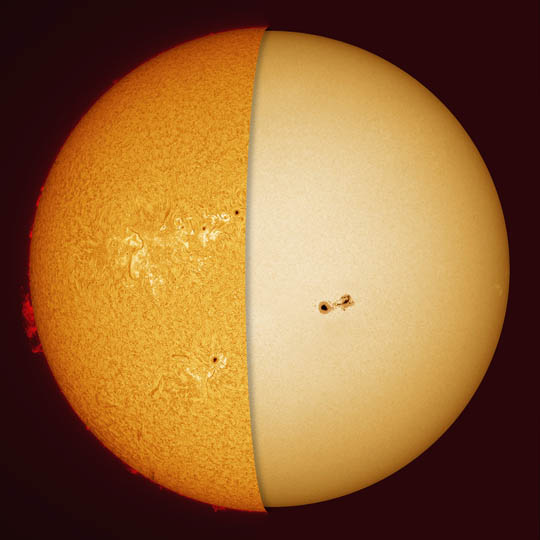 Composite image
showing the Sun in white light (right) and in H-alpha. In the red of hydrogen
light, we peer into the solar chromosphere, the layer directly above the
photosphere.
Composite image
showing the Sun in white light (right) and in H-alpha. In the red of hydrogen
light, we peer into the solar chromosphere, the layer directly above the
photosphere.
©Alan Friedman/avertedimagination.com
H-alpha light is emitted by hydrogen atoms, by far the most common element in the Sun, when electrons within those atoms absorb energy and rise to a higher energy level or orbit. When they cascade back to their original orbits, they release that energy as crimson light with a wavelength of 6562.8Å (656 nm).
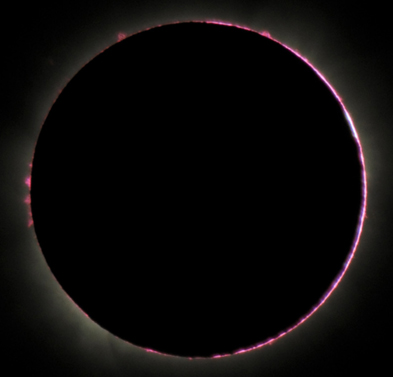 The Sun's
crimson-hued chromosphere and prominences were captured during the November
2013 total solar eclipse from Pokwero Village, Uganda.
The Sun's
crimson-hued chromosphere and prominences were captured during the November
2013 total solar eclipse from Pokwero Village, Uganda.
Alson Wong
The process occurs with great efficiency in the 1,250-mile-thick layer of solar atmosphere located just above the photosphere called the chromosphere. Here, the temperature rises from about 11,000°F to 36,000°F, hot enough to excite hydrogen to emit its singular red light. "Chromo" means color and refers to the picturesque red flames or prominences seen around the limb of the Sun when its overly-brilliant photosphere is covered up by the Moon in a total solar eclipse. The prominences, like other features visible in H-alpha light, are always there but completely swamped by photospheric glare. You either have to chase down a total eclipse to view them, or more conveniently, get a hold of a hydrogen alpha filter.
By selectively "slicing and dicing" all the other colors from sunlight until you're left with only a razor-thin slice of red light, H-alpha filters essentially create an artificial eclipse any sunny day of the year. They're even better than eclipses in one respect — not only are prominences visible, but so too are a host of other phenomena hidden for ages from human sight.
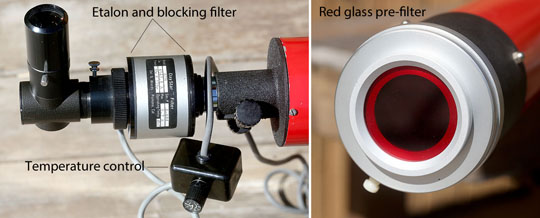 An older Daystar
H-alpha filter shows the objective filter (right) and the unit housing the
etalon and blocking filters. Many H-alpha filters are sensitive to temperature
and require a specific warm temperature to remain precisely centered on the
H-alpha line. The heater here is adjustable, so the viewer can examine
Doppler-shifted features in moving solar material by adjusting the knob pot to
examine to the object either blue-ward or red-ward of centerline. With
sophisticated optical components, some made of quartz, and temperature
controls, it's no wonder H-alpha filters aren't cheap!
An older Daystar
H-alpha filter shows the objective filter (right) and the unit housing the
etalon and blocking filters. Many H-alpha filters are sensitive to temperature
and require a specific warm temperature to remain precisely centered on the
H-alpha line. The heater here is adjustable, so the viewer can examine
Doppler-shifted features in moving solar material by adjusting the knob pot to
examine to the object either blue-ward or red-ward of centerline. With
sophisticated optical components, some made of quartz, and temperature
controls, it's no wonder H-alpha filters aren't cheap!
Bob King
H-alpha filters work by rejecting all but the narrow sliver of H-alpha light. They accomplish this feat in several steps: a red glass pre-filter over the telescope objective removes most of the shorter, bluer wavelengths at the outset, letting only red light pass through to a Fabry-Perot etalon and dichroic or blocking filter at the eyepiece end of the scope. These filters work in concert by removing unwanted light through destructive interference — the canceling out of specific wavelengths through multiple reflections — and constructive interference, where the desired wavelength is amplified and sent along to the eye.
The etalon weeds out unwanted light this way and sends the remainder to the blocking filter which removes the rest and transmits only the desired H-alpha slice.
In some of the small, dedicated H-alpha scopes available, the etalon, pre-filter, and blocking filters may be in different arrangement, but no matter the scope, they all single out the H-alpha line through a combination of filtering and destructive/constructive interference. In addition to temperature-controlled heaters for Doppler studies, smaller scopes use a mechanical tilting mechanism or "pressure tuning" to vary the wavelength of red light in small increments for Doppler studies.
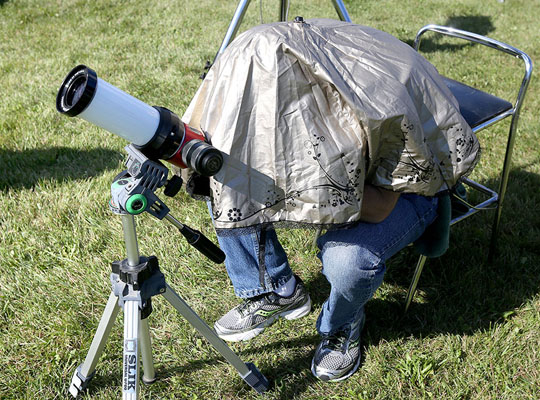 James Schaff of
Duluth, Minnesota, used a friend's Lunt LS50T H-alpha scope to study
prominences earlier this month. You'll often find H-alpha observers with
blankets, or in this case an umbrella top, over their heads when observing. The
shields help block stray light and let the observer concentrate on seeing fine
detail.
James Schaff of
Duluth, Minnesota, used a friend's Lunt LS50T H-alpha scope to study
prominences earlier this month. You'll often find H-alpha observers with
blankets, or in this case an umbrella top, over their heads when observing. The
shields help block stray light and let the observer concentrate on seeing fine
detail.
Bob King
The narrower the filter wavelength, the more off-band light is eliminated and the greater the contrast, all crucial factors for seeing details in the chromosphere. A filter with a passband of 0.7Å to 0.5Å will show both excellent surface detail and prominences, while one that transmits in the 0.9Å to 2Å range will still offer fine views of prominences, but disk details will be hard to make out due to lower contrast, i.e., too much light.
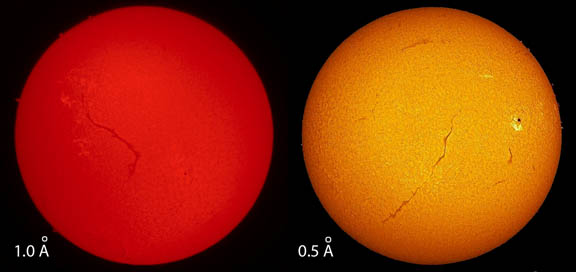 These two images
highlight the difference in disk contrast — and the amount of detail visible -
between an H-alpha filter with a bandpass of 1.0Å (left) and 0.5Å. Both images
feature long, dark filaments described below.
These two images
highlight the difference in disk contrast — and the amount of detail visible -
between an H-alpha filter with a bandpass of 1.0Å (left) and 0.5Å. Both images
feature long, dark filaments described below.
Alvaro Ibanez Perez (left) and Greg Piepol / Sungazer.net (right)
Filters and small, dedicated H-alpha refracting telescopes range in price from around $700 for a Coronado PST (Personal Solar Telescope) to $14,000 for a 0.3Å Daystar standard edition Quantum SE filter. Several companies make H-alpha filters and telescopes for amateurs:
- Lunt Solar Systems: Filter packages and dedicated solar telescopes
- Coronado (sold through Meade and other outlets): Filter packages and dedicated solar telescopes
- Daystar filters: Filter packages and the Quark H-alpha "eyepiece"
- Baader Planetarium: Filter packages
- Sky-Watcher: Dedicated solar telescopes
Back in the 1980s, only filters were available, and you had to buy a smaller pre-filter to attenuate the Sun's light and increase the telescope's focal ratio to f/30 to provide the parallel light rays the filter required to work properly. Since the introduction of the Coronado PST, the market has expanded into small, dedicated scope–filter combos that make doing H-alpha quick, easy, and more portable. Less expensive, too. You can pick up a typical unit for around $1,000 or less. A recent check on the Cloudy Nights classified advertising site turned up several small, used H-alpha scopes for around $450. With the H-alpha renaissance still going strong, there's no better time to make that step into H-a.
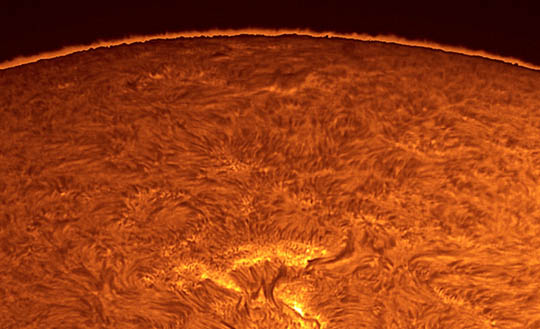 Tiny spicules,
barely resolved in this image, rim the solar circumference in "orange
fur".
Tiny spicules,
barely resolved in this image, rim the solar circumference in "orange
fur".
Greg Piepol / Sungazer.net
Once you have your filter or dedicated telescope set up and pointed at the Sun, what should you expect to see? Lots! I was first taken by the spicules (SPICK-yools) which run all the way around the edge of the solar disk and look exactly like red fur. Reality check. They're jets of hot gas between 2,000 to 6,000 miles (3,000-10,000 km) high, seen in profile. If conditions allow, try magnifying a small group of them to 100x or higher and see how long they maintain their shapes. Most last only 15 minutes before morphing into new spicules. Ever abundant, nature has seen to it that some 300,000 active spicules roil the chromosphere at any given moment.
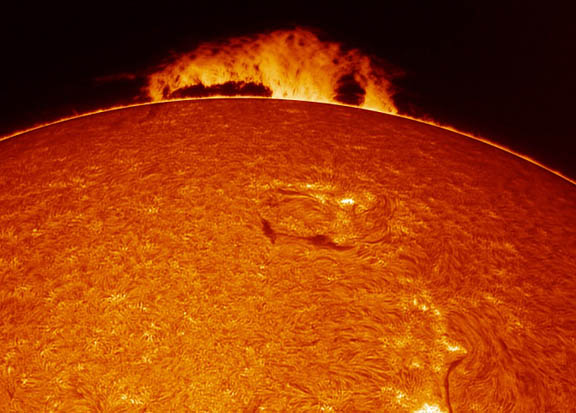 A monster quiescent
prominence photographed through a SolarMax II 60 H-alpha scope on September 17,
2015. Two days later, when the prominence rotated onto the disk, it appeared as
a prominent, dark filament. Bright white patches are "plages",
described below.
A monster quiescent
prominence photographed through a SolarMax II 60 H-alpha scope on September 17,
2015. Two days later, when the prominence rotated onto the disk, it appeared as
a prominent, dark filament. Bright white patches are "plages",
described below.
Bob Antol / stargate4173.com
Much larger than spicules and one of H-alpha's greatest highlights are the prominences. Appearing along the solar circumference, even small ones routinely dwarf Earth. Prominences are broadly divided into two categories: quiescent and active. Quiescent prominences look like hedgerows or bushes with much internal branching structure. If you keep a close watch, even one of these "quiet proms" will show structural changes in as few as 10 minutes. They're also prone to flinging part of themselves higher up in the corona in a slow-motion sort of way before the material recollects and settles back down into the chromosphere. A lava lamp comes to mind.
Active prominences are associated with flares and can be seen at the limb as brilliant blobs or, more rarely, as nested loops or sprays. If you spot one, DO NOT turn away. Surging and shape-changing in real time, not only will they take your breath away but potentially make you late for work. Ahem.
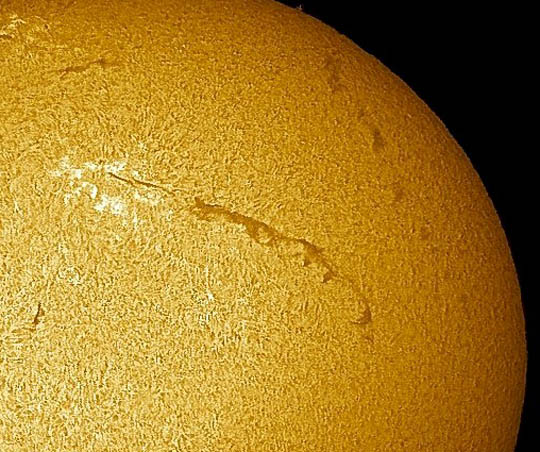 A long filament
photographed on December 6, 2004. Notice the anchoring points or
"feet" lower in the chromosphere. Prominences are relatively cool
solar plasma suspended in the chromosphere and corona by magnetic fields. They
often fall back after a few weeks but can also be ejected into space and affect
space weather conditions at Earth.
A long filament
photographed on December 6, 2004. Notice the anchoring points or
"feet" lower in the chromosphere. Prominences are relatively cool
solar plasma suspended in the chromosphere and corona by magnetic fields. They
often fall back after a few weeks but can also be ejected into space and affect
space weather conditions at Earth.
Greg Piepol / Sungazer.net
Prominences can last for many days, which means they get carried across the face of the Sun as it rotates. Seen against the bright solar disk, they're called filaments and look like bushy eyebrows and sinuous snakes with small, dark anchor points that remind me of caterpillar "feet". If you're lucky, a bright prominence will extend well into the disk as a dark filament, and you'll get to see how they're one and the same. The unique placement also reveals the prominence/filament as a grand three-dimensional arch, a sight guaranteed to ping your awe meter. Filaments can stretch halfway or more across the Sun.
Moving further into the disk, you'll suddenly realize where all that 1970s shag carpeting disappeared to. It's all over the chromosphere! What you're seeing is combination of spicules — which appear dark against the disk — and bundles of fibrils, hot plasma confined in magnetic tubes, that give the Sun a dark, mottled and swirly appearance.
Running like tendrils of glitter between and the dark mottles are tiny, moderately bright points of light called filigree. Filigree define the chromospheric network, a web-like network that outlines the Sun's supergranules, giant convective cells that transfer energy from deep beneath the photosphere up to the surface. Filigree concentrate along their edges.
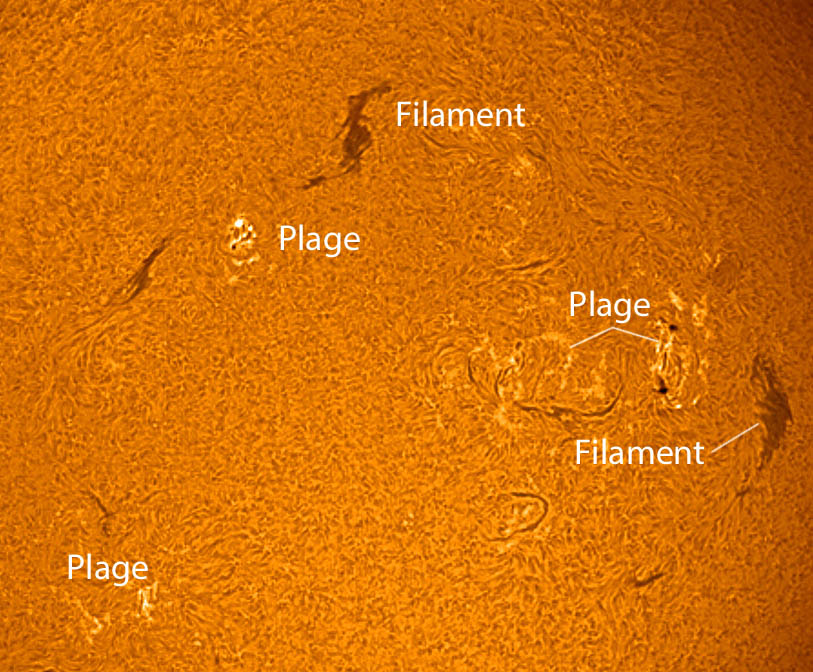 Plages and
filaments are abundant in this H-alpha image. "Plage" comes from the
French word for beach, a reference to their bright appearance.
Plages and
filaments are abundant in this H-alpha image. "Plage" comes from the
French word for beach, a reference to their bright appearance.
Alvaro Ibañez Perez / flickr.com/photos/kokehtz/
Much more obvious when looking at the H-alpha Sun for the first time are the bright, patchy plages (PLAH-jez) that mark the sites of active regions or sunspot groups. Don't be surprised if you see plage where no spot group is visible in white light. These are emerging flux regions (ERFs) where a magnetic flux tube is just breaching the surface on its way to producing a bipolar sunspot group.
As for sunspots, their dark cores or umbrae look similar to what you see in white light, but the penumbrae branch out into impressive whirls of fibrils and spicules. When the seeing is excellent, you'll see an overwhelming amount of fibril/filament and plage detail in large sunspot groups. I used to attempt to draw them but with only one life to live, soon settled on sketching just the basic outlines.
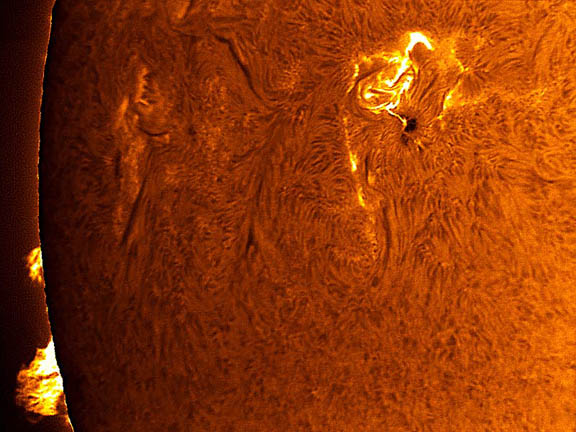 A large C-class
flare (upper right) erupts in a sunspot region on May 2, 2006. Hedgerow
prominences are visible at left.
A large C-class
flare (upper right) erupts in a sunspot region on May 2, 2006. Hedgerow
prominences are visible at left.
Greg Piepol / Sungazer.net
It's sometimes easy to confuse bright plage with a weak flare. Close inspection of large, complex plages often reveals tiny, brighter kernels of light that fluctuate in brightness. These are likely Ellerman bombs (named for an early 20th century astronomer who studied them) or tiny microflares that come and go within 5 minutes. Flares are unmistakable and involve a sudden brightening within a sunspot group often as multiple ribbons that resemble flows of white-hot lava. They can last from a few minutes to hours and change in both intensity and area in real time right before your eyes. Raw star power.
Every one of these and much more will reveal themselves to the H-alpha observer over time. During a typical viewing session, I often look at the Sun first in white light to inform my observations in the deep red. Once the filter is warmed up and ready to go, I leave it on for a couple hours for the sheer pleasure of returning time and again to see what's changed or to (hopefully) catch a flare in action. In between I'll read, eat, or invite the neighbors over for a look.
When you read of a large, rapidly developing sunspot group with a complex "delta" magnetic field, get the H-alpha scope at the next opportunity to improve your chances of seeing active prominences and the ultimate prize, a large flare.
Helpful Resources to Learn More About H-alpha Sun:
- Prairie Astronomy Club H-alpha observing guide
- Cloudy Nights Solar Observing and Imaging Forum (Great place to see current H-alpha images, get questions answered by expert amateurs)
- NOAA Solar Region Summary (Sign up for the Solar Region Summary and other Sun-related subscription services sent directly to your e-mail)
- Big Bear Solar Observatory (The link I selected will take you to the latest full-disk images of the Sun in H-alpha)
- Solar Dynamics Observatory latest images
- A.L.P.O Solar Section
- Astronomical League Hydrogen-Alpha Solar Observing Program
- The Sungrazer Observatory (Fine amateur photographs by imager Greg Piepol)
- Solar Flare Classification